

ARCHITECTURAL AND CONTEMPORARY FENCING IN THE UK
ARCHITECTURAL CONTEMPORARY FENCING
Most contemporary fencing is sold as a panel. It arrives on a pallet, it comes in one width, and the boundary has to be worked around it. That is why so many modern fences look right in the middle of a run and wrong at every corner, step and gate.
We build to the boundary instead. Metcalfe Fencing & Land Services constructs contemporary timber fencing on site and installs architectural metal and mesh systems to specification, so slat spacing, panel widths and post positions can be set out to suit the ground, the levels and the gate openings rather than the pack size.
Contact us via the contact page or call us now to discuss your requirements.
We are a CHAS accredited. A member of Construction Line. A member of The Association Of Fencing Industries. We are also Personal Track Safety (PTS) Qualified.
WHAT MAKES A FENCE CONTEMPORARY
Contemporary fencing is less about the material than about how it is set out. Four things separate it from a standard panel run:
- Horizontal lines. Boards or slats run along the fence rather than up it, which makes a garden read as wider.
- Consistent gaps. The spacing between slats is set once and held all the way along, including through the gate.
- Posts as part of the design. Slotted concrete or timber posts are either concealed or made deliberate, not left as an interruption.
- One finish. A single stain, paint or powder coated colour across fence, gate and screening.
Those decisions are all made on site with a tape measure, which is why a contemporary fence is a build rather than a delivery.
SLATTED FENCING
Horizontal slats fixed to a rail frame, with the gap set to suit what you want from it: tight for privacy, open where you want light and air through. Built on site so the slat pitch can be adjusted to finish cleanly at the last post rather than leaving a narrow offcut at the end of the run.
HIT AND MISS FENCING
Boards fixed alternately to each side of the frame, so the fence looks the same from both gardens and lets wind pass through instead of taking the full load. Worth considering on exposed boundaries and anywhere the neighbour sees the back of your fence.
LOUVRE AND SCREENING
Angled blades that block the view from one direction while keeping light and airflow. Useful for screening a patio, a hot tub, bin and bike stores or plant and air conditioning units on a commercial site, and it pairs with our decking and garden structures.
COMPOSITE AND LOW MAINTENANCE FENCING
There are many contemporary panel and board systems on the market. If you have seen one you like, in composite, aluminium or timber, we can install it. Send us the range and we will tell you honestly how it will behave on your boundary and what it needs underneath it.
ARCHITECTURAL METAL AND MESH
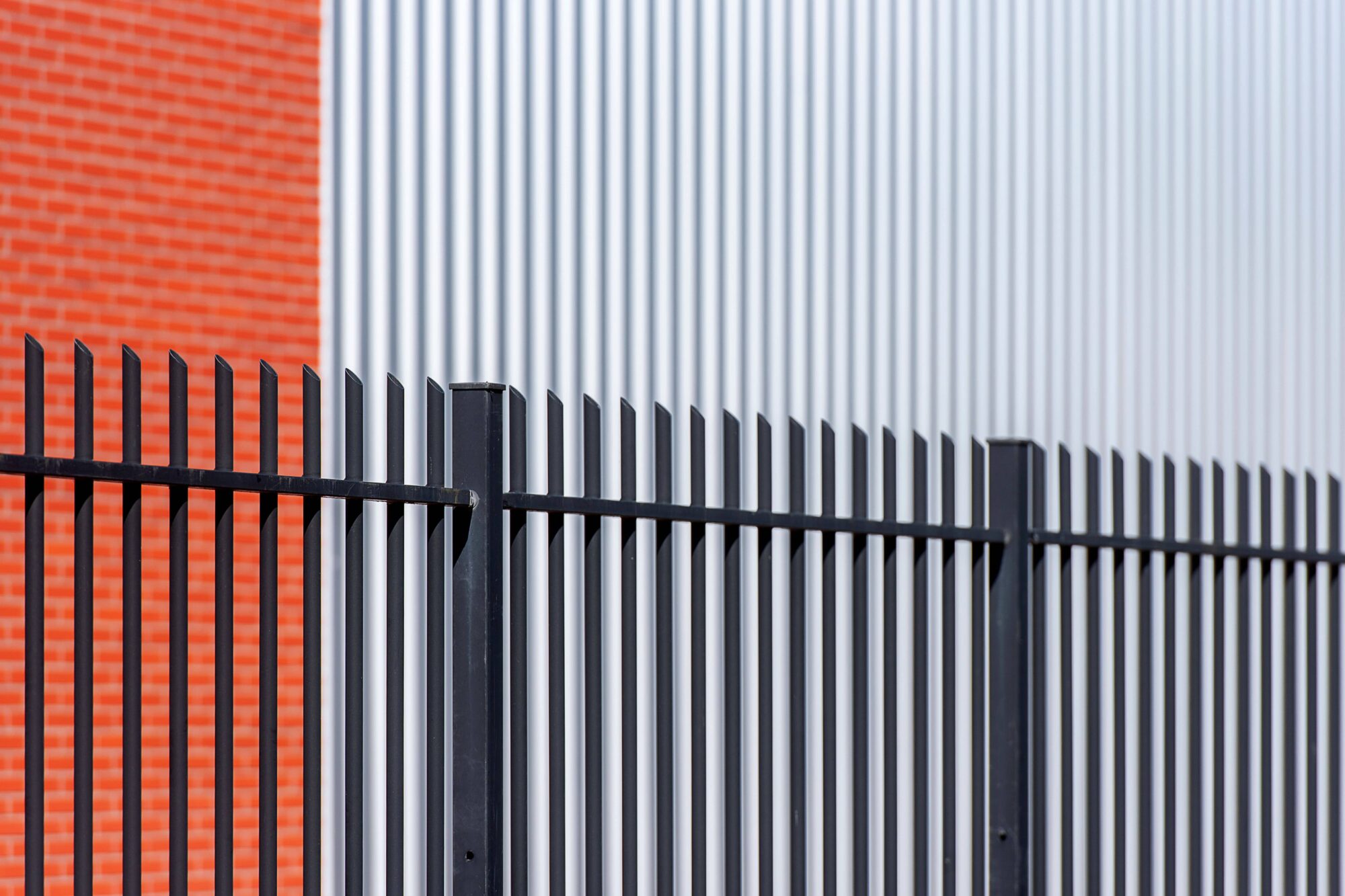
Where the boundary has to be secure as well as considered, welded mesh, vertical bar and bow top systems do both. All our metal fencing is supplied as standard with a galvanised finish, or a custom powder coated colour at extra cost, so a run can be matched to a building’s palette. See our commercial fencing page for the full range.
MATCHING GATES
A contemporary fence is undone by a gate that does not line up with it. We manufacture and fit gates to match the fence they sit in, so the slat lines carry across the opening. Gates can be automated as part of the same job: see our automated gates page.
BUILT ON SITE, NOT ORDERED BY THE PALLET
Constructing a fence on site rather than dropping panels between posts gives you three things a pallet cannot. It can follow a slope without stepping, which keeps the top line level with the ground instead of climbing in stages. It can be built around an established tree, a manhole or a change of level. And it can be set out so that both ends of the run finish on a full slat.
It also means the fence can be specified properly underneath. Timber or slotted concrete posts, with or without gravel boards, depending on the ground, the exposure and how long you need it to last. That is the same approach we take to close board fencing on our residential fencing page, applied to a contemporary design.
FOR ARCHITECTS, SPECIFIERS AND CONTRACTORS
On commercial and public sector schemes, contemporary fencing has to satisfy the drawing and the boundary at the same time. We work from your specification and are used to the constraints that come with it: matching a colour across fencing, gates and screening, keeping sightlines and demarcation clear around public spaces, and finishing neatly against new hard landscaping.
At Monks Cross Retail Park in York we core drilled post holes across a newly laid tarmac boundary to get the cleanest possible finish, and used FSC certified timber for the knee rail marking the pedestrian boundary. Read the case study.
We work on new build developments, schools and council sites. See our new build fencing and school fencing pages, or get in touch with your drawings.
HEIGHT, PLANNING AND BOUNDARIES
Contemporary fencing is often taller than what it replaces, so it is worth knowing where the line sits. In England, the Planning Portal states that you will not normally need planning permission for a new or altered fence, wall or gate provided it is no more than one metre high where it is next to a highway used by vehicles or that highway’s footpath, or no more than two metres high anywhere else.
Those allowances do not apply if any part of the site is a listed building or within its curtilage, if the boundary adjoins a listed building or its curtilage, or if the right has been removed by an article four direction or a planning condition. Rules in Wales may differ, and conservation areas have their own requirements. If you are unsure, check with your local planning authority before work starts.
We will flag it during the survey if what you are asking for looks likely to need consent.